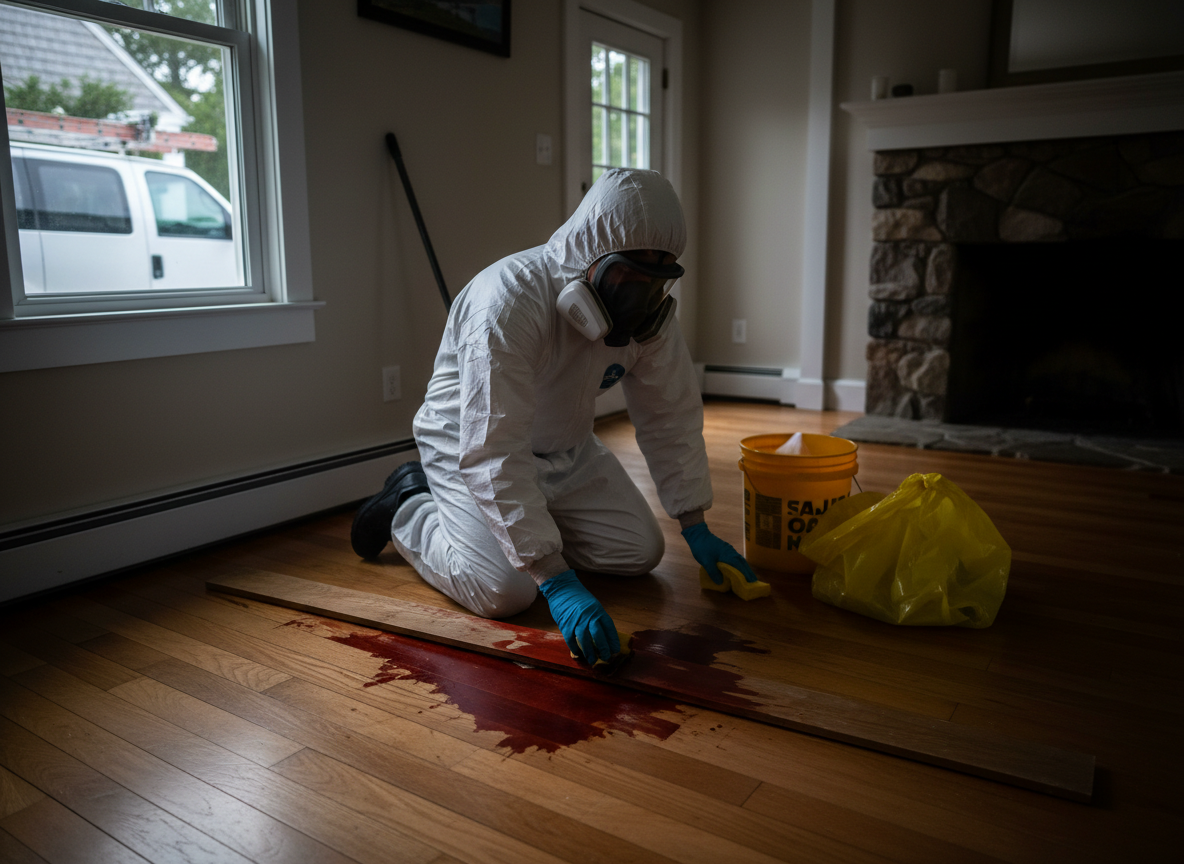
Blood spill cleanup in East Orleans requires full containment and removal of all affected porous materials because ocean-moderated humidity slows drying and allows bacteria to persist longer than in drier inland climates. Crews start by establishing negative air pressure to prevent cross-contamination into hallways or adjacent rooms common in older Cape-style homes. Every surface is treated with hospital-grade disinfectants rated for bloodborne pathogens, followed by ATP testing to confirm removal before any reconstruction begins.
In Barnstable County properties near Nauset Beach, sandy soils and shallow foundations mean spills on lower levels can migrate into crawl spaces or under slabs more easily than on higher ground. Technicians lift baseboards and check subfloors in these older structures because salt air accelerates corrosion of fasteners and can hide residual staining. All waste is double-bagged and transported for incineration according to Massachusetts biohazard transport rules.
Homeowners in Orleans and Chatham often discover dried blood weeks later when musty odors appear after a cool summer evening. The mild winters keep interior temperatures above freezing, so blood does not crystallize and flake off naturally the way it might in colder regions. This leaves a sticky residue that requires enzymatic cleaners followed by multiple HEPA vacuum passes to eliminate microscopic particles.
Edge cases include carpet pad saturation on second-floor landings where gravity pulls fluids through floor joists into first-floor ceilings. These jobs require ceiling access cuts and drywall replacement rather than surface cleaning alone. Crews document every step with photos for insurance adjusters who handle claims from properties along Nauset Beach Road and surrounding neighborhoods.
Technician insight
In East Orleans the thing that catches most people out with blood spill cleanup is how the ocean humidity keeps blood from drying completely in older homes near Nauset Beach, so what looks like a surface stain has often wicked into subfloors or under baseboards that homeowners never check.
Second-Floor Spill Migration
A homeowner in an East Orleans cottage discovered dried blood on a bedroom floor after a medical incident. We found fluid had traveled through the pine floorboards into the first-floor ceiling below. After removing the affected sections and treating the joists, the odor was eliminated and the home passed clearance testing.
Blood Spill Cleanup Services We Offer
✓Residential Blood Spill Removal
Full containment and disposal of blood from carpets, hardwood, and drywall in East Orleans homes, including crawl space checks common in older Barnstable County houses.
✓Commercial Biohazard Decontamination
After-hours cleaning of retail and office spaces in Orleans and Chatham where foot traffic must resume quickly without lingering odors or visible residue.
✓Vehicle Interior Blood Cleanup
Seat, carpet, and panel cleaning for cars and trucks parked near Nauset Beach that have experienced spills during transport to medical facilities.
✓Hard Surface Stain Extraction
Deep cleaning of tile, concrete, and sealed wood floors where blood has seeped into grout lines or expansion joints typical in Cape Cod construction.
✓Odor Neutralization After Blood Spill
Enzyme and ozone treatment to remove persistent smells that linger in humid ocean air inside closed East Orleans cottages during shoulder seasons.
Blood Spill Cleanup Cost in East Orleans, MA
| Service | Typical Range | What Affects It |
|---|---|---|
| Small residential spill under 10 sq ft | $350–$650 | Single room, no subfloor access needed |
| Standard room cleanup | $800–$1,400 | Includes carpet, pad, and baseboard removal |
| Crawl space or multi-room job | $1,600–$2,800 | Requires extra containment and material disposal |
| Vehicle interior | $450–$750 | Depends on seat and carpet saturation |
Ranges are typical for East Orleans, MA and confirmed with an exact written quote before any work starts.
How it works
- 1
Secure And Assess
Technicians arrive in marked vehicles, establish containment barriers, and document the full extent of affected materials while wearing full PPE.
- 2
Remove Contaminated Materials
All porous items such as carpet, padding, and drywall sections are cut out and double-bagged for proper disposal at approved facilities.
- 3
Disinfect And Test
Hospital-grade solutions are applied, followed by ATP swab testing to verify pathogen removal before any new materials are installed.
- 4
Restore And Document
Clean replacement materials are installed and a full report with photos is provided for insurance or property records.
Pricing
Pricing varies by square footage affected, depth of saturation, and whether structural demolition is required.